Kuvatud on postitused sildiga Electronic warfare. Kuva kõik postitused
pühapäev, 12. november 2017
laupäev, 10. oktoober 2015
3. Hardware used in Toompea castle (Tallinn, Estonia):
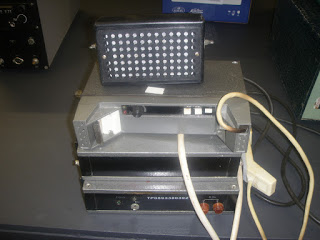
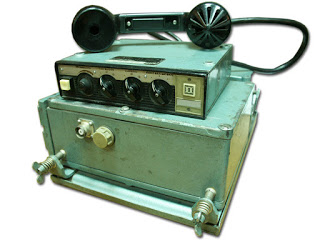
Portable tranceiver "Angara - 1"
Frequency range: 1,6 - 7,999 MHz, CW and USB mode, 10w
R - 250M
R-250, R-250M and R-250M2 where the most prominent
and remarkable Russian short wave receivers. The receiver line produced and
modernised from 1948 until 1981.
The receiver was mainly used in soviet and her allied armed forces. Later often found in HAM radio clubstations. 1.5-25.5 MHz in 12 ranges (turret tuner), with optional extension kit four additional ranges up to 33.5 MHz, AM/SSB/CW, optical projection tuning scale.
Tranceiver "Efir - M"
Transceiver Efir was produced since the end of 70s of the 20
Century. Bands: 1,8; 3,5; 7; 14; 21 and 28 mc. CW and SSB mode.
HF homebrew amplifier
About 500 Watt output
R-311
R311 – “Portable” tube military
HF receiver intended for range 1.0 – 15.0 MHz, receives AM, CW and SSB. R- 311s
were produced from the beginning of 50 till end of 1970.
R- 311 were used at a radio-
intelligence division. Then it was widely used in USSR Army- in tank, in ship,
like army headquarter monitoring receiver for receiving routine radiogram,
weather forecast, like military training receiver, etc. The receiver works well
both with short and long antennas. R- 311 practically has no rustle without an
antenna.
Homebrew "80m" tranceiver
Russian Military Aircraft Receiver R-872.
Frequency
range: 100 ...
149.975 MHz
Technical
data: Channels: 100
... 149.975 MHZ: 2000
Channel
spacing: 25 kHz Modes: AM, FM, Frequency telegraphy
R - 123 M
Transceiver
R-123: military frequency modulated shortwave / VHF
transceiver, frequency coverage 20,0 - 51,5 MHz (band 1: 20,0 - 35,75 MHz, band
2: 35,75 - 51,5 MHz, 1261 channels with 25 Khz channel spacing), optical tuning
system with frequency projected to a glass plate, operation mode frequency
modulated telephony F3, output power 20 Watts.
Baklan - 20
The airborne VHF two-way
transceivers are intended for establishing of radio communication (simplex
operation) between the crews of airplanes and helicopters and with air traffic
controllers of the ground air traffic control services.
Control of the transceiver and
setting of the demanded frequency is carried out with the help of the remote
control panel. Frequency range: 116.000 to 136.975. Output power min. 16 W, AM mode.
Modernized "Baklan-20"
| Frequency range: | 136.000 to 157.975 MHz, FM mode, 20 watt |
Modernized housing "Baklan - 20"
| Frequency range | 116.000 to 136.975, Transmitter output power, min 16 W; AM mode. |
FM Radio Receiver
Radiostation "Majak"
Receiver R - 375 "Kaira"
Frequency range: 20 - 500 MHz, spy services
R-148
is a recent fully transistorized portable radio. It was used on company
level. Frequency
range: 37.00 ...
51.950 MHz Technical data: Channel spacing: 50 KHz Modulation: FM. HF
output: 1 W.
VOLNA-K
The Volna-K is a
Russian Navy HF receiver. It was intended as a maritime receiver for the Navy
and for commercial shipping. It is a superheterodyne double conversion HF
receiver, using 17 miniature valves, and 2 semi-conductor diodes. The valves
have Russian numbers, but are equivalent to common American types. It is
intended to receive AM and CW signals down to 0.5 uV levels. The word
"volna" translates to "wave". The frequency coverage is 12
kHz to 23 mHz in 9 bands, with gaps around the IF frequencies. There are 3
versions of the Volna-K, each with a slightly different frequency coverage.
There is also Volna-P which is the version for submarines.
Radiostation "Palma"
Radiostation "Лён-БМ"
R-158
is a modern Russian Portable. It is solid state. I am trying to find out
where it was used.
Frequency
range: 30.000 ...
79.975 MHz Frequency displayed by: 4
switches
Channel
spacing: 25 KHz. HF output: 1 W Sensitivity: 1 µV Powered by: 12.6 V,
internally or externally. Temperature
range: - 40 ... + 50 °C
"Len - B"
"Len - B"
Homebrew FM tranceiver for 2m band
Portable 2m FM tranceiver
for Prime Minister
"R - 123M"
Primary jammer!
reede, 9. oktoober 2015
pühapäev, 20. september 2015
1. Jamming soviet transmissions in August 1991
On the top floor of Toompea Castle, in a room next to the attic, a radio communications center started operations on July 10, 1991, which made it possible to communicate with foreign countries, international organizations (e.g.UN), the White House in Moscow (Yeltsin’s headquarters), all the power structures under the jurisdiction of the government of Estonia, counties of Estonia, governments of Latvia and Lithuania, as well as monitor the radio communications of the Soviet Armed, Intermovement, KGB, air traffic, ship traffic, Soviet Border Guard, etc. The technology also enabled immediately establish direct contact with the opposing side. Under the roof of the castle, we established entire field of antennas in order to use different radio frequencies, while none of the antennas were visible from the outside.
The most complicated was to maintaining communications with the counties and the only possibility was to involve radio amateurs, because they existed in all of the counties. A large number of the radio amateurs at that time, whose trustworthiness was not in doubt, were involved. Naturally, they did not know where the information that they collected was going, and who was actually giving them instructions and organizing their activity. The information from the radio amateurs was not sent directly to Toompea Castle, but to specific amateur radio stations in Tallinn that directed the work of radio amateurs. At the Castle, we just had to listen in on these communications. It was agreed that the veil of secrecy would not be raised on the radio station at the Castle, because our goal was to operate only as a last resort.
The radio communications jamming group was located in another location and received direct instructions from the Toompea communications center. A total of 60 people working under my supervision to guarantee communications for the government of Estonia.
When armoured personnel carriers from Pskov arrived in Tallinn in the evening of August 19, the soldiers were relatively tired, but a radio check was the first thing they did. This provided us their working frequencies and backup frequencies. These armoured fighting vehicles had four built-in channels, as well as a fifth radio station, and we knew all the frequencies.
The most important moment was the attack on the Tallinn TV Tower. Some men from infantry went up into the tower at four or five o`clock in the morning. At the same time, the armored vehicle group took up positions around the tower. After that the unit commander communicated with the commander of The 76th Division in Tondi and reported that they were in place. He didn’t say that they are at TV tower, but it was clear to us because we were in direct contact with the Tallinn TV Tower all the times.
Thereafter, the division commander ordered them to report about the situation. In the military, this is done with the help of an ordinary code table, for instance, two-three numbers stand for some phrase. From the moment they started to read the numbers, we started jamming. The attackers tried all the reserve frequencies, however, they were everywhere confronted with our by our jammers. They did not succeed in reporting about the situation and the commander of the entire operation could not give the order to attack. We were not ready for this. We improvised, but everything turned out perfectly. We interrupted their communications for three and a half hours. No information from TV tower reached the higher command. There was a rumour that they even used a messenger.
Later, when we reviewed the recordings, a surprising fact became clear. We even had been able to jam the communications between the different Soviet Army units that were at the Tallinn TV tower in Pirita!
The communications center was in direct contact with Moscow, however the White House (Russian Parliament building) did not know that we were representatives of the government of Estonian.
Edgar Savisaar, who arrived back around at seven-eight o’clock in the evening of August 19, was in contact with the Prime Minister of Lithuania the same night via the radio communications center. The next day, Jaak Leimann, the Deputy Prime Minister, used the radio communications to consult with Lithuania.
The most complicated was to maintaining communications with the counties and the only possibility was to involve radio amateurs, because they existed in all of the counties. A large number of the radio amateurs at that time, whose trustworthiness was not in doubt, were involved. Naturally, they did not know where the information that they collected was going, and who was actually giving them instructions and organizing their activity. The information from the radio amateurs was not sent directly to Toompea Castle, but to specific amateur radio stations in Tallinn that directed the work of radio amateurs. At the Castle, we just had to listen in on these communications. It was agreed that the veil of secrecy would not be raised on the radio station at the Castle, because our goal was to operate only as a last resort.
The radio communications jamming group was located in another location and received direct instructions from the Toompea communications center. A total of 60 people working under my supervision to guarantee communications for the government of Estonia.
When armoured personnel carriers from Pskov arrived in Tallinn in the evening of August 19, the soldiers were relatively tired, but a radio check was the first thing they did. This provided us their working frequencies and backup frequencies. These armoured fighting vehicles had four built-in channels, as well as a fifth radio station, and we knew all the frequencies.
The most important moment was the attack on the Tallinn TV Tower. Some men from infantry went up into the tower at four or five o`clock in the morning. At the same time, the armored vehicle group took up positions around the tower. After that the unit commander communicated with the commander of The 76th Division in Tondi and reported that they were in place. He didn’t say that they are at TV tower, but it was clear to us because we were in direct contact with the Tallinn TV Tower all the times.
Thereafter, the division commander ordered them to report about the situation. In the military, this is done with the help of an ordinary code table, for instance, two-three numbers stand for some phrase. From the moment they started to read the numbers, we started jamming. The attackers tried all the reserve frequencies, however, they were everywhere confronted with our by our jammers. They did not succeed in reporting about the situation and the commander of the entire operation could not give the order to attack. We were not ready for this. We improvised, but everything turned out perfectly. We interrupted their communications for three and a half hours. No information from TV tower reached the higher command. There was a rumour that they even used a messenger.
Later, when we reviewed the recordings, a surprising fact became clear. We even had been able to jam the communications between the different Soviet Army units that were at the Tallinn TV tower in Pirita!
The communications center was in direct contact with Moscow, however the White House (Russian Parliament building) did not know that we were representatives of the government of Estonian.
Edgar Savisaar, who arrived back around at seven-eight o’clock in the evening of August 19, was in contact with the Prime Minister of Lithuania the same night via the radio communications center. The next day, Jaak Leimann, the Deputy Prime Minister, used the radio communications to consult with Lithuania.
Tellimine:
Postitused (Atom)